
The best AI maintenance request software for property managers is Tidio, thanks to its powerful AI chatbot that automatically collects tenant maintenance details, triages urgency, and routes requests without you lifting a finger. ManyChat is the strongest runner-up for managers who want to handle maintenance intake through Facebook Messenger and Instagram DMs, and Jotform AI Agents excels specifically at building smart, no-code maintenance intake forms that update tenants automatically.
If you manage more than a handful of rental units, you already know the pain: a tenant texts at 11 PM about a leaking pipe, another calls three times to check on a repair status, and somewhere in your inbox is a maintenance request you swear you answered — but maybe didn’t. Property managers lose hours every week just chasing and organizing these requests. The good news is that AI maintenance request software for property managers has matured rapidly, and even small operations with five or fifty units can now automate the entire intake, routing, and follow-up process without hiring extra staff. This guide walks you through exactly how to implement these tools — and which five are worth your time in 2026.

Why Property Managers Need AI Maintenance Request Software
According to the National Association of Residential Property Managers (NARPM), maintenance coordination is consistently ranked as the single most time-consuming activity for property management companies. The average small property manager spends 15–20 hours per week just on communication related to maintenance — collecting initial requests, dispatching vendors, and updating tenants on status. That’s nearly half a full-time work week on tasks that AI can largely handle on autopilot.
Beyond the time cost, poor maintenance communication is one of the top reasons tenants don’t renew leases. When a tenant feels ignored or has to chase you for updates, your retention rate drops — and every vacancy costs you real money. AI maintenance request software for property managers closes this communication gap by being available 24/7, instantly acknowledging requests, collecting structured data, and triggering automated follow-ups. It doesn’t replace your judgment; it handles the repetitive communication layer so you can focus on decisions that actually need a human.
How Does AI Maintenance Request Software Actually Work?
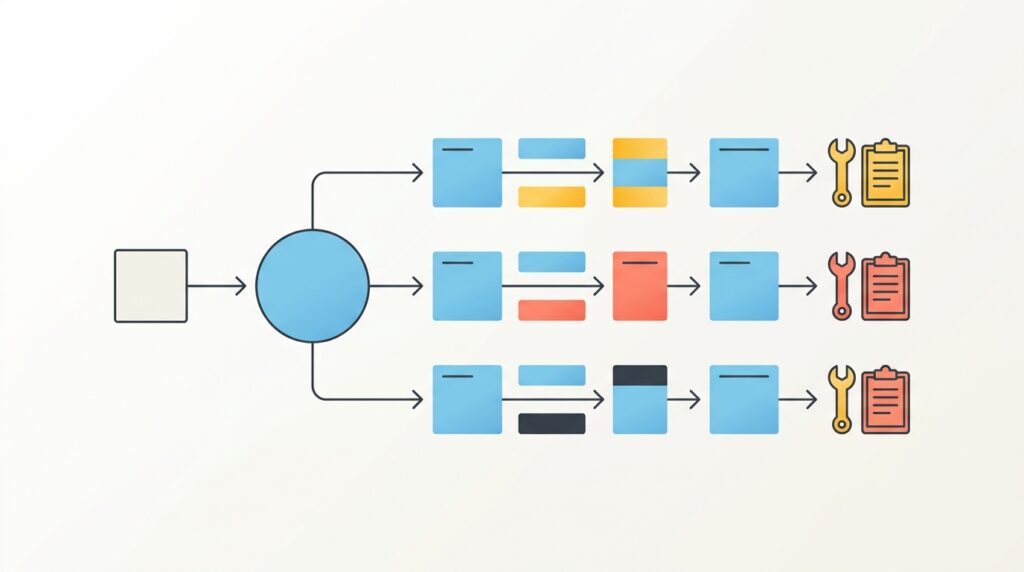
AI maintenance request software works by replacing the unstructured flood of texts, calls, and emails with an automated intake system that guides tenants through a consistent process, stores data in a searchable format, and triggers the right next actions automatically. Here’s the core workflow:
- Tenant submits a request — via a chat widget on your website, a link in a text message, a Facebook Messenger bot, or an online form. AI collects structured fields: unit number, issue category, urgency level, photos if needed.
- AI triages the request — the system categorizes the issue (plumbing, HVAC, appliance, etc.) and flags emergency vs. routine based on keywords and rules you set.
- Automatic routing — the request is sent to the right vendor or internal team member, with all the relevant details already attached.
- Tenant gets confirmation — an automated message acknowledges receipt, provides a ticket number, and gives an estimated response window.
- Status updates go out automatically — when a vendor is assigned or work is completed, the tenant gets notified without you drafting a single message.
This workflow is exactly what the five tools below enable — each in slightly different ways suited to different business sizes and setups.
1. Tidio — Best Overall AI Maintenance Chat for Property Managers
Best for: Small to mid-size property managers who want an all-in-one AI chat solution for their website or tenant portal
Tidio is the top pick for AI maintenance request software for property managers because it combines a smart live chat widget, an AI chatbot engine (Lyro AI), and a visual flow builder — all in one affordable platform. You can embed a Tidio chat widget on your property management website or tenant portal and configure it to walk tenants through a maintenance intake sequence automatically, even at 2 AM. Lyro AI, Tidio’s conversational AI layer, can answer common questions (“When will my repair be done?”, “Who do I call for emergencies?”) while simultaneously collecting structured request data.
For property managers, the practical setup looks like this: a tenant visits your site and clicks the chat widget. Tidio’s bot greets them, asks whether they’re submitting a maintenance request or have a different question, then guides them through a branching conversation that captures unit number, issue type, urgency, and even a photo upload link. All of this gets logged in Tidio’s dashboard, and you can set up email or Slack notifications so your team is alerted instantly for emergencies. Tidio also integrates natively with Zapier, which means you can push completed maintenance requests directly into a spreadsheet, your property management software, or a vendor communication tool.
Key Features:
- Lyro AI chatbot handles up to 70% of tenant inquiries without human intervention
- Visual chatbot flow builder — no coding required to create maintenance intake scripts
- Multichannel inbox: website chat, email, and Messenger all in one place
- Canned responses and AI-suggested replies speed up manual follow-ups
- Real-time visitor tracking to see which tenants or prospects are on your site
- Mobile app so you can manage requests on the go
- Zapier and native integrations for routing data to other tools
Pricing: Tidio offers a free plan (up to 50 Lyro AI conversations/month plus live chat). The Starter plan begins at $29/month, and the Growth plan with expanded Lyro AI conversations starts at $59/month. For small property managers, the free or Starter tier is usually sufficient to start.
2. ManyChat — Best for Social Media & Messaging Maintenance Intake
Best for: Property managers whose tenants already communicate via Facebook Messenger, Instagram, or WhatsApp
ManyChat is the leading platform for building automated chat flows on social messaging channels, and it’s a genuinely powerful choice for AI maintenance request software for property managers who want to meet tenants where they already are. Rather than asking tenants to visit a separate portal, ManyChat lets you deploy a maintenance intake bot directly inside Facebook Messenger, Instagram DMs, or WhatsApp — channels that many tenants check more reliably than email.
The setup is straightforward: you create a ManyChat flow that triggers when a tenant sends a specific keyword (like “maintenance” or “repair”) to your property management Facebook page. The bot immediately responds, collects the structured details you need, and can even send a follow-up sequence to confirm vendor assignment or schedule an inspection window. ManyChat’s built-in AI features help the bot handle free-form messages — so even if a tenant types “my heat isn’t working” instead of using the exact keyword, the bot can still route them correctly. You can also use ManyChat to send broadcast messages to all tenants (e.g., “Scheduled maintenance in Building A on Thursday — please reply CONFIRM to acknowledge”).
Key Features:
- Automated maintenance intake flows on Facebook Messenger, Instagram, and WhatsApp
- Keyword triggers — tenants type “repair” and the intake bot activates instantly
- AI-powered intent recognition to handle non-scripted tenant messages
- Broadcast messaging to entire tenant segments for scheduled maintenance notices
- CRM tagging to label tenants by property, unit, or request status
- Zapier, Google Sheets, and webhook integrations to push request data downstream
- SMS channel available for tenants not on social platforms
Pricing: ManyChat offers a free plan (up to 1,000 contacts). The Pro plan starts at $15/month for up to 500 contacts, scaling based on contact count. For most small property managers, Pro is the right tier.
3. Jotform AI Agents — Best for Smart No-Code Maintenance Forms
Best for: Property managers who want a structured, conversational intake form with AI-powered follow-ups and no technical setup
Jotform AI Agents transforms traditional maintenance forms into intelligent, conversational experiences that feel more like a chat than a form submission. For AI maintenance request software for property managers, this is the easiest no-code option if your priority is collecting consistent, well-structured data from every tenant submission. Instead of a static form with blank fields, a Jotform AI Agent guides tenants through questions conversationally, validates their answers in real time, and can even ask clarifying follow-up questions based on earlier responses.
A practical use case: you build a maintenance request AI Agent that asks the tenant for their unit number, then asks what type of issue they’re experiencing, then (if they say “plumbing”) automatically adds follow-up questions specific to plumbing — is water actively leaking, what fixtures are affected, and how long has this been going on. That conditional logic collects far richer data than a generic form, which means your vendors arrive with real context. Completed submissions can trigger email notifications, auto-generate a PDF work order, and sync with Google Sheets or your property management platform via Jotform’s integrations.
Key Features:
- Conversational AI form experience — guided, branching intake that feels like a chat
- Conditional logic and follow-up questions based on tenant responses
- Automated confirmation emails and PDF work order generation
- Photo and file upload fields for tenants to attach images of the issue
- 1,000+ integrations including Google Sheets, Slack, Zapier, and property management platforms
- Electronic signature collection for maintenance access authorizations
- Fully mobile-optimized for tenants submitting from smartphones
Pricing: Jotform offers a free plan (5 forms, 100 monthly submissions). The Bronze plan starts at $34/month, Silver at $39/month, and Gold at $49/month. AI Agent features are included across paid plans.
4. Buildium — Best for Full Property Management Workflow Integration
Best for: Property managers who want maintenance tracking built into a complete property management platform alongside rent collection, leases, and accounting
Buildium is a dedicated property management platform that includes a built-in maintenance request portal, automated communication tools, and workflow management — all connected to your leases, tenant records, and financials. Unlike the chat-first tools above, Buildium approaches AI maintenance request software for property managers from a whole-business perspective: every maintenance request lives alongside the tenant’s payment history, lease details, and communication log in one unified place.
Tenants submit requests through the Buildium Resident Center (a web and mobile portal), and you can configure automated acknowledgment emails, vendor assignments, and status updates. Buildium’s workflow automation handles recurring tasks — for example, automatically scheduling seasonal HVAC inspections and sending tenants advance notice. While Buildium’s AI features are less conversational than Tidio or ManyChat, the operational completeness it offers is unmatched for managers who are tired of juggling multiple disconnected tools.
Key Features:
- Tenant-facing Resident Center portal for maintenance request submission and tracking
- Automated maintenance request acknowledgments and status update emails
- Vendor management with work order creation and job assignment
- Maintenance request history tied to each unit and tenant record
- Task and inspection scheduling with automated tenant notifications
- Owner reporting that includes maintenance spend summaries
- Mobile app for tenants, owners, and property managers
Pricing: Buildium’s Essential plan starts at $58/month for up to 150 units. Growth plan starts at $183/month with added features like eLeases and advanced reporting. Premium starts at $375/month.
5. Zapier — Best for Connecting Your Existing Maintenance Tools
Best for: Property managers who already use multiple tools (a form tool, email platform, spreadsheet, or PM software) and want AI-powered automation to tie them all together
Zapier is the connective tissue of the modern property management tech stack. If you already have a maintenance intake form (Jotform, Google Forms, Typeform), a communication tool (Gmail, Slack), and a spreadsheet or PM software for tracking — Zapier’s AI automation capabilities can wire them all together so that a tenant submission in one place automatically triggers actions in every other tool. For AI maintenance request software for property managers who don’t want to rip out their existing setup, Zapier is the least disruptive and most powerful upgrade.
Zapier’s AI features in 2026 include AI-powered Zap building (you describe what you want in plain English and it builds the automation), AI formatting steps that can extract and classify maintenance request details from unstructured text, and multi-step workflows called Zaps that handle complex conditional logic. Example: a tenant emails your maintenance address → Zapier’s AI reads the email, categorizes the issue type, creates a row in your Google Sheet tracker, sends the tenant a confirmation email, and posts an alert in your Slack channel — all automatically, without any manual step from you.
Key Features:
- AI Zap builder: describe your automation in plain English, Zapier builds it
- AI formatting steps to parse and classify unstructured maintenance requests
- 6,000+ app integrations — connects virtually every property management tool
- Multi-step Zaps for complex conditional maintenance routing workflows
- Scheduled Zaps for recurring maintenance reminders and inspection notices
- Tables and Interfaces features to build lightweight internal maintenance trackers
- Team collaboration features so multiple staff members can manage automation
Pricing: Zapier’s free plan covers 100 tasks/month with 5 single-step Zaps. The Professional plan starts at $19.99/month, and the Team plan at $69/month. Most small property managers find the Professional plan sufficient.

Quick Comparison Table: AI Maintenance Request Software for Property Managers
| Tool | Best For | Starting Price | AI Features | Ease of Setup | Free Plan? |
|---|---|---|---|---|---|
| Tidio | AI chat intake on website/portal | $0 / $29/mo | Lyro AI chatbot, flow builder | ⭐⭐⭐⭐⭐ Very Easy | Yes |
| ManyChat | Messenger/Instagram/WhatsApp intake | $0 / $15/mo | Intent recognition, AI flows | ⭐⭐⭐⭐⭐ Very Easy | Yes |
| Jotform AI Agents | Smart conversational intake forms | $0 / $34/mo | Conversational AI, branching logic | ⭐⭐⭐⭐⭐ Very Easy | Yes |
| Buildium | Full PM platform + maintenance | $58/mo | Automated workflows, notifications | ⭐⭐⭐ Moderate | No |
| Zapier | Connecting existing tools via automation | $0 / $19.99/mo | AI Zap builder, text parsing | ⭐⭐⭐⭐ Easy | Yes |
How to Implement AI Maintenance Request Software Step by Step
Knowing which tools to use is half the battle. Here’s a practical step-by-step implementation guide for small property managers rolling out AI maintenance request software for the first time:
Step 1: Audit Your Current Maintenance Intake Process
Before adding any software, write down exactly how tenants currently submit requests and how you currently process them. Are requests coming in via text, email, phone calls, or a mix? How long does it take from submission to acknowledgment? Where do requests fall through the cracks? This audit tells you which pain points the software needs to solve first.
Step 2: Choose Your Primary Intake Channel
If tenants mostly contact you through your website, start with Tidio. If they use Facebook Messenger or Instagram, start with ManyChat. If you want to send tenants a dedicated link (via text or email) that takes them to a smart form, start with Jotform AI Agents. Don’t try to launch on all channels simultaneously — pick one, get it running smoothly, then expand.
Step 3: Build Your Maintenance Intake Script
Map out the questions your intake flow needs to ask: unit number, contact info, issue category, urgency (emergency vs. non-urgent), description, and whether photo evidence is available. In Tidio and ManyChat, this becomes a chatbot flow. In Jotform, it becomes a form with branching logic. Keep it under 8 questions — tenants abandon long forms quickly.
Step 4: Set Up Routing and Notifications
Configure your tool to send an automatic confirmation to the tenant and an alert to you or your team when a submission comes in. For emergency requests (water leak, gas smell, no heat in winter), set up a separate notification pathway — SMS or phone call — so they never sit unread. Use Zapier to connect your intake tool to your property management platform or a shared Google Sheet if they don’t integrate natively.
Step 5: Create Status Update Templates
Write 3–5 template messages: (1) request received, (2) vendor assigned and ETA confirmed, (3) work completed, (4) follow-up satisfaction check. Load these into your tool as automated triggers or canned responses. This alone eliminates the majority of “what’s the status of my repair?” calls.
Step 6: Test With a Real Request Before Going Live
Submit a test maintenance request yourself, going through the entire flow as a tenant would. Check that the confirmation email looks professional, the right person got alerted, and the data landed in the right place. Fix anything that feels confusing — if it’s unclear to you, it will be unclear to your tenants.
Step 7: Communicate the New Process to Tenants
Send a one-time email or text to all tenants explaining the new system, sharing the link or channel to use, and emphasizing that it’s faster and easier than calling. Include the link in your lease welcome packet going forward. Tenant adoption is the biggest practical hurdle — make it easy for them to find and use the new intake method.

For a broader look at how AI is changing how landlords and property managers communicate with tenants, check out our guide on How to Use AI Chatbots for Property Managers — it covers the full communication lifecycle beyond just maintenance. And if you’re thinking about upgrading your entire tech stack, our Best AI Automation Tools for Property Managers in 2026 breaks down the top platforms for end-to-end workflow automation.
The Bottom Line
If you’re a small property manager ready to stop losing hours to maintenance chaos, here’s the clearest path forward:
Start with Tidio as your primary AI maintenance request software. It’s the most versatile, easiest-to-configure, and most affordable option for handling maintenance intake through your website or tenant portal. The Lyro AI chatbot handles the majority of incoming requests autonomously, and the visual flow builder lets you customize the intake script to match your exact process — no developers needed. The free plan gives you a real head start before you spend a dime.
Add ManyChat if your tenants are active on Facebook Messenger, Instagram, or WhatsApp. At $15/month for the Pro plan, it’s one of the lowest-cost ways to run a fully automated maintenance intake channel on the platforms your tenants already use daily. Together, Tidio and ManyChat cover your website/portal and your social messaging channels — and the two tools complement each other without overlap.
For managers who want a full-platform solution and don’t mind a higher price tag, Buildium is the right choice — especially once you’re managing 20+ units and need maintenance tracking connected to leases, accounting, and owner reporting in one place. And if you already have tools you love and just need to connect them intelligently, Zapier is the automation glue that makes everything work together seamlessly.
The bottom line: AI maintenance request software for property managers isn’t a luxury in 2026 — it’s the difference between running a professional, scalable operation and spending every evening answering the same tenant questions manually. Pick one tool from this list, implement it this week, and reclaim your time.

Frequently Asked Questions
What is AI maintenance request software for property managers?
AI maintenance request software for property managers is a category of tools that uses artificial intelligence and automation to collect, organize, route, and track tenant maintenance requests without requiring manual intervention for every step. These tools typically include chatbots, smart forms, or automated messaging flows that guide tenants through submitting requests, then trigger automated confirmations, vendor alerts, and status updates. The goal is to reduce the time property managers spend on communication while improving the tenant experience through faster, more consistent responses.
How much does AI maintenance request software cost for a small property manager?
AI maintenance request software for property managers ranges from free to around $375/month depending on the tool and feature tier. Tidio and ManyChat both offer free plans that are genuinely functional for small operators, with paid plans starting at $29/month and $15/month respectively. Jotform AI Agents starts at $34/month on the Bronze plan, Zapier’s Professional plan is $19.99/month, and Buildium (the most full-featured option) starts at $58/month. Most small property managers managing under 50 units can implement a highly effective AI maintenance system for $30–$60/month total.
Can AI maintenance request software handle emergency repair requests?
Yes, most AI maintenance request software can be configured to identify and escalate emergency maintenance requests — such as flooding, gas leaks, or no heat — using keyword detection and urgency-level fields. In Tidio and ManyChat, you can set up separate conversation flows for emergencies that immediately trigger an SMS or phone call to you or an on-call vendor rather than routing through the standard process. It’s important to clearly communicate to tenants that life-threatening emergencies should always involve calling 911 first, with your AI intake system handling non-life-threatening urgent repairs.
Do tenants need to download an app to use AI maintenance request software?
No — the best AI maintenance request tools for property managers require no app download from tenants. Tidio runs as a chat widget directly on your website, ManyChat works through Facebook Messenger and Instagram (which most tenants already have), and Jotform AI Agents are accessible through any mobile browser via a shareable link. Buildium does have a Resident Center mobile app but also works through a web browser. The no-download experience is critical for adoption — tenants are far more likely to use a system that works instantly without friction.
How long does it take to set up AI maintenance request software for my properties?
Most property managers can have a basic AI maintenance request system live within one to three hours using tools like Tidio, ManyChat, or Jotform AI Agents. The core setup involves building the intake flow (30–60 minutes), configuring notifications and routing (20–30 minutes), and testing the full tenant experience (15–20 minutes). More complex setups — connecting multiple tools via Zapier or configuring Buildium’s full workflow — may take a few days. Starting with a single intake channel and simple flow is the fastest path to getting value from the software immediately.
Affiliate Disclosure: This article contains affiliate links. If you click a link and make a purchase or sign up for a service, we may earn a commission at no additional cost to you. We only recommend tools we have genuinely researched and believe provide real value to small business owners. Our editorial opinions are independent and are not influenced by affiliate relationships.